Today, competition is the continuous effort companies make to offer the customer more value, to hold a sustainable place in the market, and to stand apart from their rivals.
Competition used to be about price alone. Customers now weigh many things together: quality, speed, innovation, service, reliability and sustainability.
In lean thinking, companies use a range of tools to build a sustainable advantage under today's competitive conditions.
Flow is one of the basic principles of lean production. It means that value-adding work moves forward in line with what the customer wants, without interruption, without waiting, and without creating waste. Put another way, the aim is for the product or the service to travel from raw material to the customer without stopping, without going backwards, and without building unnecessary stock.
Definition of flow
The right product moving through the process at the right time, in the right quantity, and without interruption.
The basic features of flow
- Value-adding work moves forward without interruption.
- Waiting time is cut to a minimum.
- Unnecessary stock does not build up.
- Material, information and processes work in step with each other.
- Customer demand directs production.
- Waste is removed.
What flow provides
| When flow is in place | Result |
|---|---|
| Waiting falls | Lead time gets shorter |
| Intermediate stock falls | Cost falls |
| The process speeds up | Productivity rises |
| Errors are seen early | Quality rises |
| The workload is balanced | People's productivity rises |
| Customer demand is answered quickly | Customer satisfaction rises |
The seven core flows in lean production
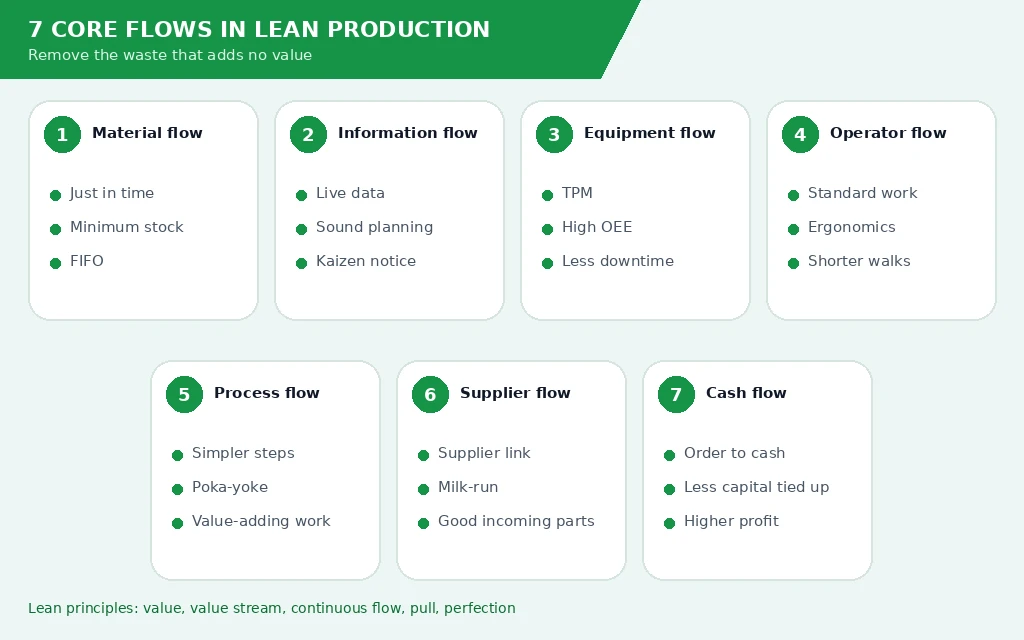
Lean management aims to focus inside the company. Concentrating on the flows that happen there removes waste and gives the firm the financial strength it needs in the fight to compete.
Material flow
Material flow covers raw materials, subassemblies and assembly, and it is the foundation of efficient production. Managing this flow well prepares the ground for productivity across the whole process and builds a solid base for operational excellence.
Aim: Stop material piling up on the line, which is excess stock, and keep it moving on the just-in-time principle.
Tools: FIFO (first in, first out), kanban, pull system.
Information flow
Information flow is the nervous system of any production operation. It coordinates the work and makes informed decisions possible.
It is the whole stream of data and communication, from taking the customer order, through planning production orders, out to the suppliers. Information that is wrong or late disrupts the entire production chain.
Aim: Get information to the right person, at the right time, complete, and free of confusion.
Tools: value stream mapping (VSM), visual management, andon and kamishibai boards.
Equipment flow
Equipment flow challenges the old idea of machines as fixed and immovable, and it changes how manufacturers look at their production assets. It stresses the value of flexible, adaptable equipment that teams can reconfigure quickly as production needs change. Companies that understand equipment flow in depth can succeed. It is the working rhythm of the machines, the tools and the production lines. Stoppages, breakdowns and how well the machines stay in step with each other are what this flow is about.
Aim: Reduce machine stoppages, drive breakdown time towards zero, and build flexible production lines.
Tools: TPM (total productive maintenance), SMED (single-minute exchange of die), OEE (overall equipment effectiveness).
People and operator flow
This is the physical movement of operators inside the production area. It looks at the steps a person takes while assembling, changing a machine setting, or collecting material.
Aim: Cut unnecessary walking, bending, reaching and movements that are poor for the body. These are forms of waste.
Tools: standard work, spaghetti diagram, cellular production.
Process flow
This covers the passage of the product from design into production, and the standardisation of the processes. It is the flow of the methods and technologies that decide how the product will be made.
Aim: Simplify the process steps, remove unnecessary approval mechanisms, and stop errors at the design stage.
Tools: poka-yoke (error proofing), DFM (design for manufacture).
Supplier flow
This is the logistics and collaboration flow between the factory and the outside world, its suppliers. Lean production does not stop at the factory gate. Suppliers have to keep up with the same pace.
Aim: Build long-term relationships with suppliers based on trust, shorten material lead time, and secure the quality of incoming material.
Tools: milk run, logistics management, supplier integration.
Cash flow
This is the financial side of the production processes. It looks at how long the money invested, in raw material, labour and the rest, takes to come back as cash collected from the customer.
Aim: Free the cash locked in stock, and cut the order-to-cash cycle to a minimum.
Tools: calculating process cost, waste analysis.
Lasting change in a company's processes is never easy. Small, repeated steps built into daily work can still transform the whole organisation and carry it further along the road to excellence. Analysing the seven flows, and improving them continuously through kaizen, can give a firm a real advantage in building a competitive edge.
