Lean production system
- Details
- Written by: Super User
- Category: Lean production system
- Hits: 151
Visual tools make complex information easier to understand. They also help the whole team speak the same language, move in the same direction, and make decisions more quickly. They are a practical way to ensure that the process proceeds without problems in the production environment. Understanding and sharing information quickly is extremely important in the management of a business. For this reason, using visual management tools affects the efficiency of lean production. Thanks to these tools, everyone on the team can easily see what is going on. Problems can be detected quickly, and people can work better together. Visual management tools include many different techniques and systems. Kamishibai is also one of the important visual management tools used in lean production.
Formed from the combination of the Japanese words kami (paper) and shibai (theater/play), this technique originates in the illustrated scrolls that Buddhist monks used to tell stories in temples in the 8th century.
The Kamishibai Board
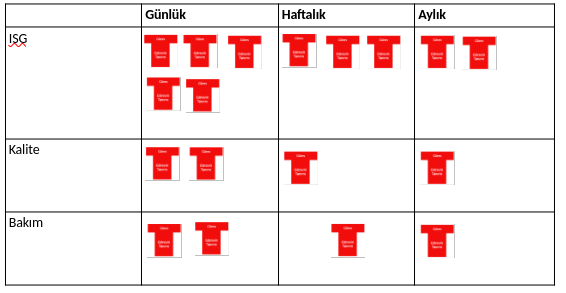
It is an extremely effective Visual Management tool that shows, at a glance, the status of the standard audits and routine jobs that must be done on the shop floor (Gemba). The basic logic of the board rests on the "T-Card" system. Two-colored cards (generally one face Green, the other face Red) are used for each task.
- 🔴 Red Face: It shows that the task has not yet been done, or that the time for the check has come.
- 🟢 Green Face: It shows that the task has been completed successfully and conforms to the standards.
Read more: Application of the Kamishibai Board in Visual Warehouse Management
- Details
- Written by: Super User
- Category: Lean production system
- Hits: 133
If you spend time in the Production, Warehouse, Purchasing, and Procurement units, you will frequently come across the following conversations. • We could not find the material; can we bring a new one right away?
- There is no material; clear the line as soon as possible, we are going to produce the other product!
- The semi-finished goods and materials inside the line are waiting because a part is missing.
- Production cannot keep up; our number of operators is insufficient.
- For reasons beyond our control we will not be able to make the shipment; it will be a little late, unfortunately.
- Those parts are sitting somewhere in the warehouse; please search and find them as soon as possible!
- We should assign other people as well to search for the material!
- There is too much work in the warehouse; our number of personnel is insufficient.
- Our warehouse space is insufficient; we are working with scarce resources.
- We skipped issuing the goods; the record stayed in inventory.
- These are the parts we searched for and could not find! When we changed its shelf, we forgot to make the address change in the system.
- This part was written on the delivery note; we did not look inside the boxes. The wrong material had come.
- We did not look inside the boxes; it was short.
- The other day they asked for it from production, saying it was urgent; we gave it, but we did not issue it.
- Every job is urgent; we cannot do them all today!
All of these problems come from certain recurring errors that arise in storage processes. Coming across these problems is inevitable, but what matters is how often they are experienced. In the table below, let us try to define the potential problems one by one and to set out their consequences.
- Details
- Written by: Super User
- Category: Lean production system
- Hits: 127
As with everything else, in the lean production system too, change management determines how much of your targets you will achieve. It is clear that a change process that is not applied correctly will cause resistance to lean production techniques to form in the company. You then also become unable to carry out many applications that you could carry out. For example, one of the things we encountered at a company we have recently been consulting is that, although they had carried out 5S work for a long time, they had been unable to make any progress. The answer to the question "Does the lean production system fit your company?", which I ask in many seminars, is in fact very important because it shows people's basic approach. What needs to change? This is what determines how much of the lean production system will be applied.
Many managers, company owners, and engineers think that the lean production system can be adapted to their companies. That is, they think the main elements of the company's current state will be preserved, and that they can use some lean production techniques in a number of side applications. They believe the current state must be preserved to a large extent. As the basic reason for this, they say that their production and their products are very different, and that applying the lean production system as a whole is impossible. A manager from headquarters even came to the Turkey branch of one of our customers (German-owned) in order to explain that the lean production system could not be applied. He explained at length that their products were very special, that they did not do serial production, and that the lean production system, and Kanban in particular, could never be put into practice, and then he left. As a result, we put Kanban and the pull system into practice and brought the delivery time down from 35 days to 3 days. The basic reason for this condition of managers, especially if they have worked for many years, is that they have come to believe they were somehow the best at their work and that they think they are now at the limit of improvement. How much of a priority change is, is also proved here. In this form the company will gradually lose the market and fall behind. It is necessary to change and develop as soon as possible, and to put innovations into practice.
- Details
- Written by: Super User
- Category: Lean production system
- Hits: 145
Managing inventories is of vital importance for a company. I am not talking here about the greatest Muda that lean production speaks of. I am talking about controlling inventories with the IT we know. My experience has shown that a considerable number of companies in Turkey do not know their inventories, and therefore do not know their costs or their profit position. That being so, they essentially have owners and managers who make decisions the way one drives a vehicle in thick fog, with eyes closed and entirely by feeling. What is interesting is that there are quite a few managers and owners who think that, once they make an agreement with a software company, they will control their inventories. They put these thoughts into practice as well, and the result is companies that spend millions of lira and still cannot control their inventories.
Software companies, for their part, step outside their own field and, supposing that an inventory management system is something that solves itself once the software has been built, put into practice solutions one could not imagine, and what emerges here too is Excel tables transferred into IT software.
Yet inventory management is a system in its own right. Whichever software you do it with, if you do not set the system up correctly you have no chance of a successful application in inventory management. It is exactly at this point that lean logistics, an important part of the lean production system, comes before us. Together with lean logistics, many concepts have entered the processes of inventory management. In this way inventory management finds its real worth. Maximum efficiency is obtained from the software, and inventory, one of the most important of the 7 Muda, can be brought under control. Let us touch on what must be done on the software for lean logistics and inventory management; let us try to explain the related concepts; let us talk about examples of application.
1- Master data for inventory control must be complete and integral. Lean logistics software systems define the master data required for inventory control as follows. The concepts given are data that must be provided in addition to the basic data required for inventory control — for example stock code, name and unit, and accounting codes, and so on. - Acquisition lead times: supplier production time, transit time, transfer time, order-preparation time, and so on.
- EOQ; economic acquisition quantity; economic order quantity, production quantity, and so on. These must be calculated on the basis of the cost of consumption and of acquisition.
- - MOQ; minimum acquisition quantity; minimum order quantity, production quantity, and so on. These should be calculated by working together with the supplier, or according to the costs of production changeover.
- - Packaging information; packaging types, quantities contained in a package, package volume information, and so on.
- - Acquisition types; determining types such as supply to stock, supply to order, subcontracted supply, and so on. Here the item in question will need additional data according to the appropriate supply system. Of these, maximum stock quantity, safety stock quantity, and lot size are the most widely used.
- Details
- Written by: Fatih Sütçüler
- Category: Lean production system
- Hits: 162
After acquiring information about the Lean Production System (LPS), almost every manager is seized by the thought that they must apply this system in the operation immediately. As you also follow from the articles on the site, the LPS is a production model made up of many modules, in which all losses have disappeared and which runs smoothly. In the final analysis, the system aims to increase efficiency and profitability. The LPS is an ideal system that can produce these results as a consequence of every one of its elements being applied at the highest level.
We stated in previous articles that the transition to the LPS is an important change and that this change must be managed very carefully. Whatever the subject, in order to carry the change through, the transition process must be managed within a plan and with patience.
Read more: Transition Strategies to the Lean Production System
