The situation
In a company, material is one of the most important things to manage. Production losses are often caused by material arriving late, or by buying far more than is needed, which then leaves the plant short of space and short of cash. ERP and MRP systems set up to manage material correctly depend on plans. Those plans are only as reliable as they are accurate, and when management does not fully control that link, material problems remain one of the lasting major problems.
Customer orders are another problem companies struggle to manage. Almost every company tries to run a production plan based directly on customer orders, and then tries to use that same plan to manage every material. As a result, supplying the material and running production keep damaging order lead time, and directly hurt the company's market share and its growth from year to year.
What is kanban?
This is where kanban, as used in the lean production system, comes in as the solution. Kanban is the only system that puts the product and the material where we want it: on time, in exactly the quantity needed, and in exactly the place it is needed. In that respect it is unique. No other system meets these three conditions at the same time. The structure of kanban is shown in the picture below.
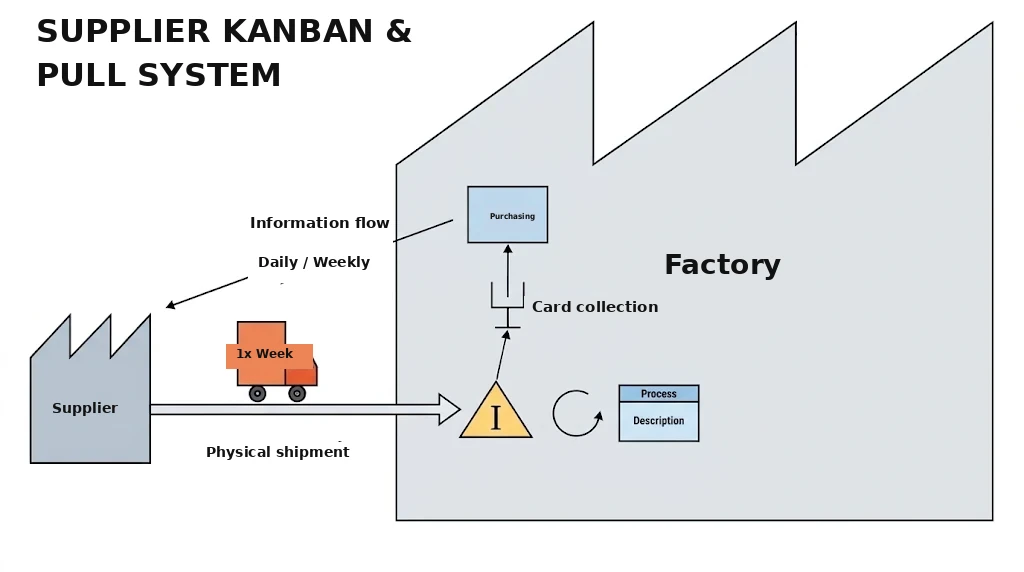
Supplier kanban diagram
After a good deal of analysis and calculation, material can be in the plant exactly on time. In current ERP and MRP systems, the stock that has to be held changes with the lead time the supplier has promised. In a correctly calculated kanban system, plant stock changes independently of that lead time, according to the information flow, the minimum order quantity and consumption.
How do you move to a kanban system with a supplier?
A kanban system can be set up for the materials provided by any supplier to your company. You do not have to sign a contract with the supplier to do this. A contract is treated as a "nice to have". The stages of the changeover can be listed as follows:
- Selecting the material: at this stage you decide which materials will join the kanban system. Materials in the AX, BX, CX and AY groups of an ABC-XYZ analysis are usually selected.
- Putting the supply data in order: lead time, minimum order quantity, pack quantities and freight information are analysed.
- Doing the kanban calculations: kanban quantities, the number of cards and lot sizes are calculated.
- Defining and building the kanban flow: decisions are made on the kanban flow, the boards, how the cards will be collected, and how they will be attached to the material. Boards are prepared, cards are printed, and the people who will use them are trained.
- Go-live: a preliminary simulation is run at the start, and the whole system is put into operation.
Problems you may encounter
The application usually starts without problems, but occasionally some will appear. The analysis stage, and the simulations before go-live, are the right points to find these problems and take precautions. Problems can still appear. From time to time, poorly trained employees, calculation errors, and quantities drifting because the kanban system is not maintained regularly, create mistakes. These problems are:
- Running out of stock because cards are lost or not collected on time
- Kanban signals being triggered too often because conditions have changed
- The supplier changing the lead time without telling you
- Employees ordering without a kanban card: a panic order
- The physical space not matching the kanban quantity, so there is not enough room
- Sudden swings in demand, tenders and similar situations not being taken into account
