















5S is, in essence, a disciplined way of life at work, at home, in the car—in short, in every area of our lives. We have all wanted to find an item we use correctly and ready for use every time, or to find anything we might need within 3 seconds. Searching, and especially searching in a way that wastes time in those unlucky moments when everything has piled on top of everything else and the customer is waiting for the product, is the worst situation.
There is a cooking program on the German channel RTL; its name is "there is no such thing as tasteless food". In the program the presenter, who is also the cook, prepares the dishes live, and the guests eat well too. The food is of course not our subject. Our subject is the presenter's way of working: he quickly finds the various utensils and the food ingredients at hand, and he finishes the program without leaving any rubbish behind. There is no dish prepared in advance; at the same time he prepares and serves 3-4 kinds of dishes and a dessert. That is discipline, complete harmony with the work environment, and a very well arranged kitchen. The man does his job as smoothly as a poem.
5S is the art of creating an environment that will bring people into complete harmony with their work environment, an environment in which they can find anything they will need while doing the job, ready for use, within 3 seconds. It actually consists of 5 steps that are simple, clear, easy to understand, and that require a decision and implementation. It also requires people's habits to change. That is where the difficulty arises.
5S steps
As we also mentioned above, 5S consists of five steps. For these steps, which are expressed by five Japanese words beginning with "S", the Turkish equivalents have been translated in different ways in different sources. Here, so that they remain consistent with "5S", we also chose the Turkish equivalents from words that begin with "S". These are;
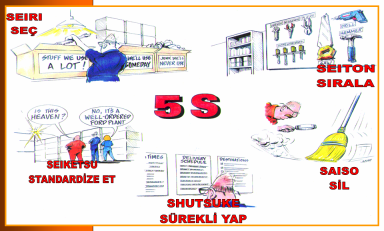
1- Sort (Seiri)
In this step, the machines, tools, molds, materials, documents, and similar items found in the work environment are divided into two groups: necessary and unnecessary. Those that are necessary are then classified as frequently used, infrequently used, and very infrequently used. The unnecessary ones are removed from the work area, listed, and the list is submitted to management so that a decision can be made about them.
2- Set in Order (Seiton)
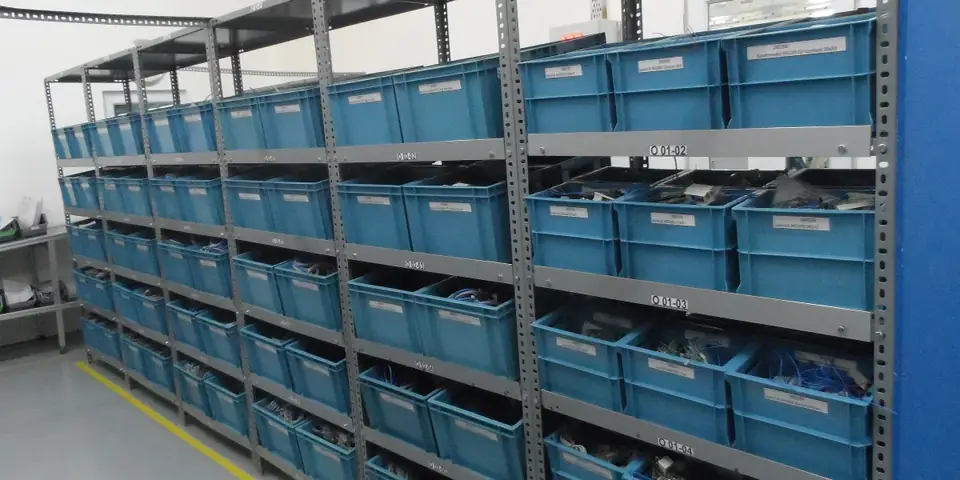
In this step, everything that has been separated out as necessary is placed and marked so that anyone can find it within 3 seconds. Everything must be marked in order to prevent searching. The marking must also be able to show that a tool which is not in its place is not in its place. What matters here is that people personally believe in the benefit of finding things easily, and that they become accustomed to putting everything they take back in its place in a disciplined way.
Ergonomics must be provided in the work environment. The arrangement must be such that the employee can find, with eyes closed, the product they use or consume. In this way the employee's life is made easier, and therefore the continuity of the changes is ensured. It should not be forgotten that one aim of our 5S practice is also the improvement of employees' conditions.
During set-in-order practices, an effort should be made to eliminate the 7 Muda. The operator's searching for material or a tool, which is one of the most important causes of the 7 Muda, is largely eliminated by set-in-order practices.
During set-in-order practices, it is also important to try to eliminate the need for tools. In this way, the number of tools you will have to put in place and later find will decrease. For this, you need to standardize the tool in line with its purpose of use. With a short study carried out for this purpose, the number of many wrenches, screwdrivers, Allen keys, and similar items can be reduced to one or to a few. These changes will also reduce the model changeover time.
3- Shine (Seiso)
As can also be understood from its name, this step is carrying out cleaning. Cleaning continuously is not a sensible approach here. The first important thing that must be done is to ensure that the environment and the system stay clean. Naturally, the practice that must be carried out is work to prevent sources of contamination. This is also the cheapest solution.
Combining cleaning operations with TPM practices is important. Because, while cleaning is being done, many parts of the machine or the facility pass through one's hands. This situation should be taken advantage of, and signs of wear, looseness, and deterioration can be checked on the parts that are touched; in this way, the places on the machine or the facility where maintenance should be applied are also revealed.
For cleaning practices, every employee should have a cleaning duty plan. These duties should be defined and applied on a daily, weekly, and monthly basis. Every employee should contribute to cleaning. While the employee cleans the machine and the workplace, the manager should also keep their own desk clean and orderly.
4- Standardize (Seiketsu)
This step is one of the most difficult steps to apply. Here, an effort will be made to turn practices that have previously been completed successfully into the standard in all departments of the company. To be able to do this, the improvements that have been made must be adopted by all employees. Employees must be helped to understand thoroughly the benefit of the improvement.
Slogans, a reward system, training, and teamwork are tools that can be used.
5- Sustain (Shitsuke)
Turning what was done in the first 4 items into a way of life, and ensuring discipline, is the highest stage to be reached. For it to be reached, the company's senior management must attend to the subject, motivate the employees, and audit what is done in a disciplined way.
5S information boards, weekly audits, informing senior management, rewards, and similar practices are tools that can be used here.
